



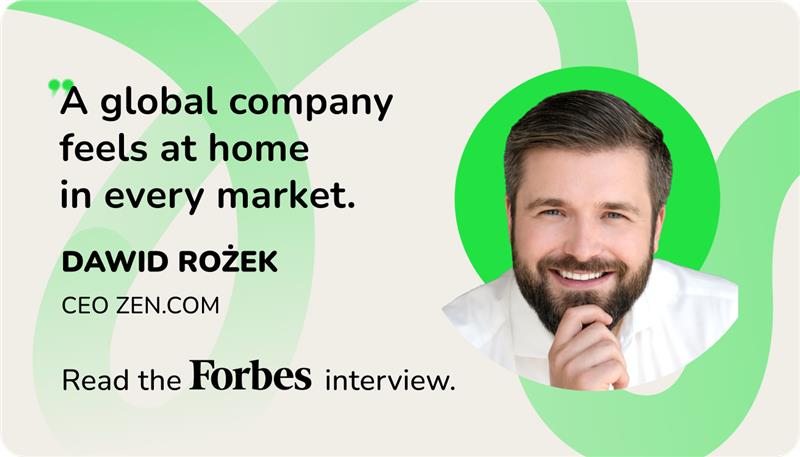
In a Forbes interview, Dawid Rożek shares how ZEN.COM is being built into a truly global fintech – from navigating regulation and scaling internationally to combining global ambition with strong local execution.
FORBES: How many interviews have you given in your life?
DAWID ROŻEK: Not many – just a few. I don’t feel the need to speak publicly if I don’t have something important to communicate. Besides, I prefer to first achieve what we’re planning and only then talk about it.
So why did you decide to speak out now?
It comes from a business need. With ZEN.COM, we’re starting to step out of the shadows, applying for additional licenses and building a truly global business. A company operating in a heavily regulated industry should have a face—and ideally, that face should be its owner’s. But this is just this one interview. There won’t be another for a long time.
In that case, people should get to know you a bit. Do you like risk?
I’ve learned to live with it. I accept that it’s necessary if you want to do ambitious and innovative things. It’s an inseparable part of the game.
I thought you liked it, since a few weeks ago, during a conversation with Tomasz Fornal on Kanał Zero, you offered that ZEN.COM would cover the costs of the Polish volleyball team’s stay in the Philippines if they won the world championship gold medal.
That was quite spontaneous… But in reality, I didn’t take a huge risk. It might have cost us some money, but ZEN.COM would have gained great promotion, and the volleyball players would have won the championship. I was rooting for them hard, but it ended with a bronze medal.
Bringing Andrzej Duda onto the supervisory board, however, is a risk. The company immediately gets a political label.
Only in Poland. Globally, a company employing a former president is perceived as strong and effective – and right now, what matters to us most is the global perspective.
So is this a way for you to build credibility?
Absolutely. When you operate in a highly regulated industry, relationships and reputation can be more important than the functionality of your system. Bringing in such a person is a huge value for the company. It can make things move forward.
How do you hire a former president?
It started with President Duda inviting me on an official state delegation to Singapore, where discussions were held about financial innovation and cooperation between countries. It was a great honor for me, and at the same time an opportunity to see a head of state in action. I won’t hide the fact that his energy and determination made a strong impression on me. I didn’t expect that kind of work to be so intense. Some time passed after that delegation, President Duda completed his term, and I came up with the idea of inviting him to join our board, hoping he would support us in relations with regulators and in obtaining further licenses. And he agreed.
Thanks to the appointment of Andrzej Duda, ZEN.COM became widely talked about, but your entrepreneurial story is much, much longer. In 2018, you appeared on the “30 Under 30” list thanks to another business – G2A. You wrote to me back then: “From the age of 17, I sold gold and in-game items. My goal was never to build a ‘company,’ but rather to scale what I was doing more and more.”
That’s true. My first motivation was to show my friends and my parents that I was capable of something, that I was good at something. That something turned out to be computer games. I got so into it that I became one of the best players in the world in World of Warcraft and Diablo 2. Then I started wondering whether I could achieve something similar in another field. The first thousand złoty I earned selling gold or in-game items tasted amazing – much better than the far larger sums I earn today. The constant drive to improve my level, which I took from gaming, eventually translated into business. Of course, building companies is far more complex than any game, because it involves countless variables. But that’s what makes it more interesting.
How did G2A begin?
I started out as a seller of virtual game items on Allegro. At some point I thought: why not start trading games themselves? So I began buying them from some players to sell them to others at a higher price. Eventually, the scale of this activity became serious, so I wanted to take the next step: build my own platform for trading games. The problem was that I was a teenager and had no idea about business or finance. I needed to find someone who could help me.
And that’s when Bartosz Skwarczek appeared.
Not immediately – he didn’t reply to my first message. But I was determined, kept pushing, and eventually he agreed to meet. At first, he supported me in an advisory role, and after six months I proposed that we work together on the project. We came up with the idea of building a place where people from all over the world could trade games. It was very important to us that it be an international marketplace from the very beginning, because we knew that only then could we build an attractive offer and a truly large business. And that’s how, in 2010, we launched a platform that became a global leader in the sale of game keys and, over time, other digital products as well.
One that has sparked huge controversy in the industry for years. The company is regularly accused of facilitating trade in stolen game keys, and some publishers have suggested that people pirate games rather than buy them on G2A, because they don’t get anything from it anyway. What is your attitude toward these accusations?
For years, Bartek and I had two different perspectives. Because of my background, I always stood on the side of gamers. I wanted them to have access to cheap games and believed that publishers wouldn’t become poorer because of us—which, of course, they didn’t like. That was closer to my libertarian, slightly rebellious DNA. Bartek, on the other hand, tended to side with publishers. Despite these differences, for many years we managed to grow the business by reconciling different approaches.
Until a certain point – when you decided to go your separate ways.
That’s right. ZEN.COM was my project from the very beginning, although Bartek supported me. At some point, around the turn of 2019 and 2020, things naturally evolved so that Bartek focused more on gaming, while I fully concentrated on ZEN.COM, because that was the direction I wanted to pursue further. The scale of both businesses already required separate structures, teams, and strategies. From 2020 onward, I devoted myself almost exclusively to ZEN.COM – it was a time of building foundations: the team, technology, and legal framework.
Did Bartosz Skwarczek buy out your shares in G2A?
Simplifying: yes. We carried out a complex operation that considered legal, tax, and organizational issues. In 2022, we finally separated our main assets, and each went our own way. But we still like each other and talk often. To this day, I have enormous respect for Bartek. He’s 11 years older than me, and at the beginning his experience was invaluable. I learned a great deal from him. He was my mentor.
In 2018, you wrote to me that you were building a “global bank under the ZEN.COM brand.” ZEN is not a bank.
And in fact, it was never meant to be one. Maybe that’s what I thought at the very beginning, but in reality I simply wanted to create an international organization with financial products—though not loans. This stemmed from the fact that we were constantly creating solutions for clients: something like an internal PayPal that allowed fast transfers between sellers and buyers, or our own payment gateway to handle international transactions. At some point, I wanted to make this entire ecosystem of financial solutions for gamers available to everyone.
The first ZEN.COM product was precisely the payment gateway. Only later did you add others, such as multi-currency cards, business accounts, or cashback.
That came naturally. First, we created an online payment gateway tailored to e-commerce, connected to a bank account and enabling cheap international transactions. Then we started thinking about what else users needed. That’s how further solutions were born – multi-currency accounts, business cards, or instant cashback. We always create products in response to real customer needs.
Were you inspired by Revolut, founded in 2014, which stormed the financial market and became one of Europe’s most valuable startups?
I supported it – and still do – in its fight against outdated banking, but it’s a different business from ours, with a different DNA. I don’t come from finance; I come from e-commerce. We design our solutions with companies and users who conduct international transactions in mind – such as instant settlements or the instant cashback I mentioned earlier. Just as I once always stood on the side of gamers, now I stand on the side of the smaller players: e-commerce entrepreneurs and users to whom the old financial world doesn’t offer convenient services.
Which product is your main growth driver?
It’s hard to point to just one. Some customers highly value instant cashback, which is a simple product at the intersection of finance and e-commerce: you pay with a ZEN.COM card at one of the thousands of stores we work with and receive an immediate refund of up to 40% credited to your account. Our extended warranty for purchases made with a ZEN.COM card is also very popular, giving users extra peace of mind for more expensive transactions. People who travel a lot most often use the multi-currency account and card, which allow them to pay in dozens of countries. Others frequently exchange currencies through ZEN.COM at attractive rates. For entrepreneurs, it’s especially appealing that thanks to our payment gateway, they can offer customers a wide range of payment methods.
How have you financed ZEN.COM so far?
I’ve been able to do it on my own, without external capital. I chose greater risk – but also greater independence.
And how much did it cost you?
Until reaching profitability, I spent over 50 million złoty on ZEN.COM. This includes investments in technology, licenses, product security, and team development. That level is comparable to the spending of global fintechs in their early stages. The fact that I used my own money benefited the business. I knew ZEN.COM had to stand on solid foundations before we started scaling. Some investor-funded startups forget this. They pursue growth at any cost to inflate valuation and reach unicorn status as quickly as possible. Unfortunately, that tactic is often short-sighted and ends in problems.
ZEN.COM can provide its services in the European Union, the United Kingdom, and Singapore. Have you gone through the regulatory “rite of passage”?
Let’s just say that when we started this business, I didn’t have a single gray hair (laughs). It’s a tough process – and I understand why, because regulators bear enormous responsibility. On one hand, they want to support innovation; on the other, they can’t let into the market someone who shouldn’t be providing financial services. When we started, only one company in Poland had an EMI license and never really began operating. It was the Lithuanian regulator who first recognized our potential and invited us into the licensing process, which ended with the license being granted in 2018. After two more years, we were ready to launch sales in Europe. In 2024, the UK joined in. As for Asia, Singapore was a conscious and strategic expansion direction – we wanted to be there from the start. Fortunately, at an early stage we established contacts with partners in Singapore who believed our solutions could genuinely help companies in the region. Thanks to that, we were able to execute our plan faster than originally expected.
How so?
Singaporeans invited us to talk because they saw how our services could support their businesses – also in the context of operations in Europe. It fit perfectly with our strategy, so we naturally seized the opportunity. And now we’re moving forward: we’re applying for a license that will allow us to operate in Hong Kong as well. Asia is a huge market with enormous potential, enabling us to scale the business to an entirely new level.
Several successful fintechs have already emerged in Poland, such as BLIK, PayPo, or Autopay. Most of them, however, succeed locally or at best regionally. Why should you be able to build a global business?
It’s primarily a matter of mindset, which brings courage in action. Poles shouldn’t be afraid to build global businesses, because in terms of competence, we lack nothing. We don’t have to be the world’s assembly line – we can create innovations that others will follow. And entrepreneurs who try to do this, thereby bringing money into Poland from around the world, should receive state support in the form of relational leverage – like we did when we were invited to Singapore. On the product level, standardized solutions should be created and then adapted to local needs. You must understand the game well: in one market, additional transaction security may be crucial; in another, adding a currency for international settlements; in yet another, partnering with a popular local player. A global company is one that feels at home in every market. And that is our goal.
How has the internationalization of ZEN.COM gone so far?
Very promisingly. We operate in 31 countries of the European Economic Area, and about 80% of ZEN.COM’s revenue already comes from foreign markets. We’re doing particularly well in Lithuania, Romania, Spain, and France. We’re not dependent on any single market. Now we’re starting to acquire customers in Asia. In the next step, we may also open up to Ukraine. We see that more and more Ukrainians are using our products, and additionally we cooperate with PrivatBank, the largest commercial bank in the country.
In the early years, ZEN.COM recorded losses, but then you started growing rapidly. Between 2021 and 2024, the revenue of your Lithuanian company – the most important in your group – grew from €8.7 million to €93.9 million, and you turned a €3.2 million net loss into €24.7 million in net profit. You’re practically doubling the business year over year. Where does this acceleration come from?
From the fact that we accelerated slowly. Some time had to pass before we obtained the necessary licenses and achieved operational efficiency. It’s not easy to build from scratch a company that can efficiently manage international finances, has a wide range of products and integrations with local financial service providers, and responds to the needs of very different groups of people and businesses. Many elements must work together for this ecosystem to function properly. But once you’ve built it, you can reach a point where customers start seeking out your solutions themselves. And that’s exactly where we are now.
What do your key metrics look like?
In 2025, we expect to exceed PLN 500 million in revenue with satisfactory profitability. We have over one and a half million users and 10,000 B2B clients. More than 700 partners already offer our cashback, including many very popular brands. We employ around 600 people spread all over the world – though, of course, the largest number is in Poland. I like to say that our heart beats in Rzeszów, where we come from, but our mind has moved to Kraków and Warsaw, where access to talent is easier.
Are you the sole owner of the business?
Yes. We have a highly dispersed holding structure consisting of many companies. Each has its own management and operating principles tailored to individual markets, but I personally oversee the entire business.
And you don’t feel lonely? No partners to share responsibility with, no intellectual sparring partners?
I have great managers who are excellent sparring partners.
I know that as early as eight years ago you were interested in artificial intelligence, because you were then seeking contact with Wojciech Zaremba from OpenAI, a co-founder of what was then a nascent non-profit organization. What role does AI play at ZEN.COM?
An increasingly important one. Some time ago, we concluded that there was no point in trying to build our own models, as it would be too expensive. However, we use various open-source solutions that improve our daily work, internal processes, and products.
For example?
We build AI agents that support our users in the purchasing process and help clients with onboarding. Or that summarize daily data on customer sentiment toward our brand. Or that support the compliance department in creating rules ensuring that our solutions operate in accordance with the law in each market. In fact, there are very few areas in the company where AI isn’t used anymore. People are increasingly focused on supervising models and drawing conclusions from their work.
You have further licenses and expansion directions planned. Will there also be more high-profile hires like Andrzej Duda?
There will be.
Politicians?
People who are authorities in various fields, who are ready to believe in what we’re doing and can support us from a marketing or reputational perspective. We’re looking for ambassadors all over the world.
And where do you personally spend most of your time – Poland, Asia, or airplanes?
Unfortunately, lately I’ve been mostly traveling and in business meetings. I say “unfortunately” because I get the greatest pleasure from coming up with new products, but given the current nature of the business, I have less time for that. Which doesn’t mean I’ve stopped doing it.
You’re 36 years old, and ZEN.COM is your second successful business. Will there be a third?
There will. But for now, I can’t reveal anything more.
Will you sell ZEN.COM to build another company?
No. ZEN.COM is not a company for sale. We’re not developing it for money. I want to build my legacy with this business – to prove that a Pole can do it, that nothing stands in the way of creating global technology companies. That is my core motivation. I hope that when I give another interview in a few years, I’ll be able to inspire someone with my story.
And then will it be time for Buddhist zen – calm, silence, balance, slowing down?
Zen is reserved for customers – we want using financial services to be safe and stress-free for them. But I have a different idea for myself. I’m driven by agency and impact. I’m built in a way that wouldn’t let me stand still. Life can surprise you, but for now I’m not planning an early retirement.

